1. Process Control & Optimization
-
Raw Material Inspection:
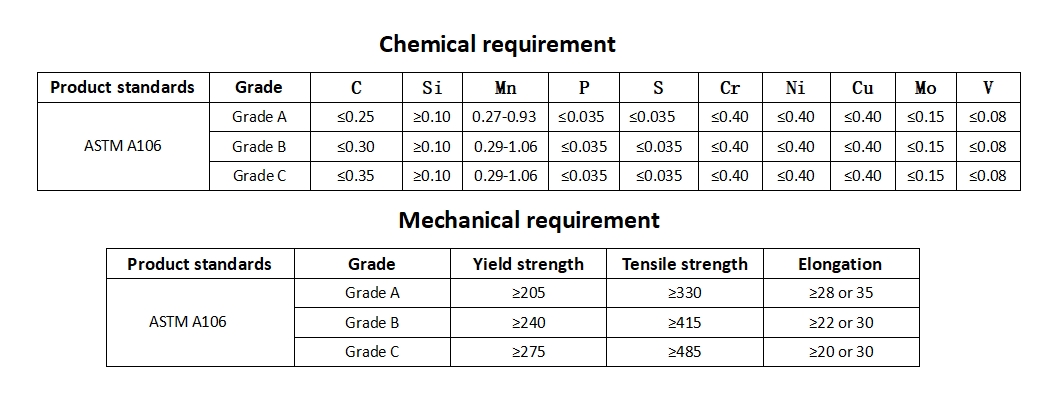
- Incoming steel billets or plates undergo chemical composition analysis (spectroscopy) and mechanical testing (tensile, hardness) to verify compliance with grade specifications (e.g., carbon content ≤0.30% for ASTM A106 B)
- Supplier audits and material traceability systems ensure consistency in raw material quality
- Incoming steel billets or plates undergo chemical composition analysis (spectroscopy) and mechanical testing (tensile, hardness) to verify compliance with grade specifications (e.g., carbon content ≤0.30% for ASTM A106 B)
-
Precision Forming:
- Seamless Pipes: cold drawing techniques are standardized to achieve uniform wall thickness (±0.1 mm tolerance) and dimensional accuracy
- Seamless Pipes: cold drawing techniques are standardized to achieve uniform wall thickness (±0.1 mm tolerance) and dimensional accuracy
-
Heat Treatment:
- Normalizing or annealing processes are calibrated to relieve internal stresses and enhance mechanical properties (e.g., yield strength ≥30 ksi for boiler tubes)
- Normalizing or annealing processes are calibrated to relieve internal stresses and enhance mechanical properties (e.g., yield strength ≥30 ksi for boiler tubes)
2. Advanced Detection Technologies
-
In-Process Monitoring:
- Ultrasound & Eddy Current: Detect internal flaws (e.g., laminations) and surface cracks with micrometer-level resolution
- Laser Scanning: Measures wall thickness, diameter, and ovality at multiple points along the pipe
- Ultrasound & Eddy Current: Detect internal flaws (e.g., laminations) and surface cracks with micrometer-level resolution
-
Automated Systems:
- Robotic arms with vision systems inspect weld seams for uniformity and alignment
- IoT-enabled sensors track temperature, pressure, and deformation during rolling to optimize process parameters
- Robotic arms with vision systems inspect weld seams for uniformity and alignment
3. Pre-Shipment Quality Assurance
-
Final Inspection Checklist:
- Visual & Dimensional Checks: Confirm surface smoothness (no scratches >0.1 mm deep) and compliance ASTM standards
- Non-Destructive Testing (NDT):
- Hydrostatic Testing: Pressurize pipes to 1.5× design pressure to detect leaks
- Radiographic Testing (RT): Identify weld imperfections using X-ray or gamma-ray imaging
- Hydrostatic Testing: Pressurize pipes to 1.5× design pressure to detect leaks
- Visual & Dimensional Checks: Confirm surface smoothness (no scratches >0.1 mm deep) and compliance ASTM standards
-
Certification & Documentation:
- Material Test Reports (MTRs) and third-party certifications (e.g., TÜV, SGS) validate compliance
- Batch tracing systems link production data to final products for accountability
- Material Test Reports (MTRs) and third-party certifications (e.g., TÜV, SGS) validate compliance
4. Workforce Training & Quality Culture
-
Skill Development:
- Regular training on welding techniques, ASTM standards ensures operator proficiency
- Certifications (e.g., ASNT Level III) for quality inspectors mandate strict adherence to protocols
- Regular training on welding techniques, ASTM standards ensures operator proficiency
-
Continuous Improvement:
- Lean manufacturing initiatives (e.g., TPM for equipment efficiency) reduce waste and downtime
- QC circles and employee-led problem-solving (e.g., Six Sigma projects) address recurring defects
- Lean manufacturing initiatives (e.g., TPM for equipment efficiency) reduce waste and downtime
5. Compliance & Sustainability
-
Regulatory Adherence:
- ISO 9001/Q1 certifications mandate systematic quality planning and risk mitigation
- Environmental audits ensure compliance with emissions and waste disposal regulations
- ISO 9001/Q1 certifications mandate systematic quality planning and risk mitigation
-
Waste Reduction:
- Scrap recycling programs and energy-efficient furnaces lower environmental impact
- Scrap recycling programs and energy-efficient furnaces lower environmental impact
Key Outcomes
- Defect Rates: <0.5% rejection rate through multi-layered inspections
- Customer Satisfaction: Consistent quality reduces returns and enhances brand reputation
By integrating technology, rigorous protocols, and a culture of excellence, steel pipe manufacturers ensure products meet the highest industry benchmarks while maintaining competitiveness in global markets.
Please feel free to contact as below:
Catherne, yz_catherine@163.com